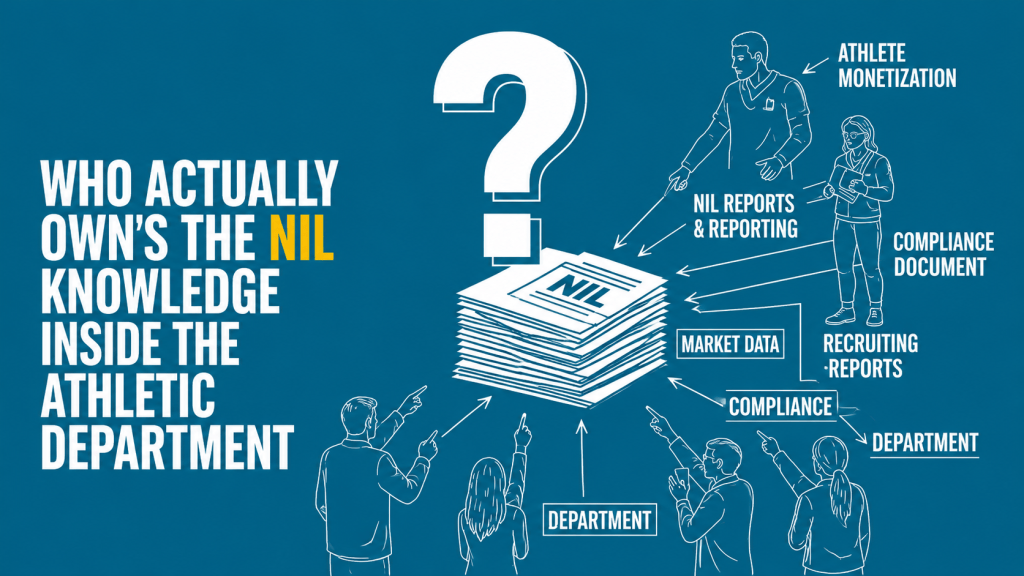
NIL STRATEGY & COMPLIANCE SUMMARY
- Strategic Role: An NIL Director serves as the primary bridge between the athletic department, student-athletes, and external third parties like NIL collectives and corporate brands.
- Compliance Focus: Responsible for ensuring all deals adhere to the patchwork of NCAA interim policies, evolving state laws, and institutional “Internal Control” protocols to protect eligibility.
- Commercial Growth: Manages group licensing programs (e.g., jersey sales, video games) and leads student-athlete education in financial literacy, contract law, and personal branding.
- Operational Impact: Transitions athletic departments from a “reactive/risk-aversion” posture to a “proactive/revenue-enablement” model.
Table of Contents
- The Genesis of the NIL Director
- Pillar I: Navigating the Regulatory Minefield (Compliance & State Law)
- Pillar II: The Collective Liaison & Donor Relations
- Pillar III: The Student-Athlete Educator & Brand Consultant
- Pillar IV: Group Licensing, Merchandising, and EA Sports
- The Business Case: Why This Role is Now Non-Negotiable
- The Future: Revenue Sharing and Employment Status
- Conclusion & Strategic Call to Action
- References & Citations
The Genesis of the NIL Director
Before July 1, 2021, the infrastructure of a college athletic department was built on the foundation of amateurism. Compliance officers spent their days tracking $50 handshakes and making sure a booster didn’t buy a recruit a sandwich. The moment the Supreme Court ruled on Alston v. NCAA and Name, Image, and Likeness (NIL) became the law of the land, that foundation collapsed.
In its place emerged a high-stakes, multi-million dollar marketplace. Athletic Directors quickly realized that “Compliance” could no longer just be the Department of No. They needed a strategist, a liaison, and a brand builder. Enter the Director of NIL.
This isn’t just a mid-level management position. The NIL Director is the Chief Strategy Officer of the most volatile asset in college sports: the athlete’s market value. They are tasked with balancing the legal rigor of a general counsel with the marketing savvy of a Madison Avenue executive.
Pillar I: Navigating the Regulatory Minefield (NCAA Compliance & State Law)
The primary responsibility of an NIL Director is “Institutional Protection.” Currently, there is no federal NIL law. This leaves NIL Directors to manage a chaotic three-tiered system of regulations:
- NCAA Interim Policies: Rules regarding “pay-for-play” and recruiting inducements.
- State Legislation: Laws that vary wildly from Florida to California, often granting athletes more rights than the NCAA allows.
- Institutional Policies: The specific “Code of Conduct” rules set by the university (e.g., no deals with gambling, tobacco, or adult entertainment companies).
An NIL Director must vet every deal submitted through the university’s disclosure portal. When a star quarterback signs a six-figure deal with a local car dealership, the NIL Director ensures the contract doesn’t require the athlete to miss practice (a “pay-for-play” violation) or use university logos without a license.
Tactical Compliance Management:
- Audit Trails: Maintaining a digital paper trail of every transaction to defend against potential NCAA inquiries or “Notice of Allegations.”
- Conflict Resolution: Identifying where a student-athlete’s personal sponsor (e.g., Pepsi) might conflict with the university’s master rights holder (e.g., Coca-Cola).
- Legislative Advocacy: Working with university lobbyists to influence state law changes that keep the school competitive with rival programs in other states.
Pillar II: The Collective Liaison & Donor Relations
If the athletic department is the “Church,” the NIL Collective is the “State.” For the uninitiated, NIL Collectives are third-party organizations—often run by prominent boosters—that pool donor money to pay athletes for “work” such as social media posts or appearances.
While the NCAA initially tried to keep these entities at arm’s length, the NIL Director is the vital point of contact. They cannot run the collective (that would be a violation of institutional control), but they must facilitate communication.
The Balancing Act:
- Strategic Alignment: Ensuring the collective is focusing its resources on the sports and positions that the coaching staff deems most critical for roster retention and recruitment.
- Donor Education: Meeting with high-net-worth individuals to explain that their donations are no longer just for stadium bricks and mortar, but for the “Talent Fund” represented by the collective.
- Governance: Reviewing collective contracts to ensure they meet the university’s ethical standards and do not create Title IX imbalances that could trigger federal lawsuits.
Pillar III: The Student-Athlete Educator & Brand Consultant
The most impactful part of the NIL Director’s role is direct engagement with the athletes. Most 18-year-olds are not prepared to manage the tax implications of a $50,000 income boost or the legal jargon of a five-page marketing contract.
The NIL Director acts as a “General Manager” for the student-athlete. They don’t find the deals—that’s the agent’s job—but they provide the tools for the athlete to succeed once a deal is found.
The Educational Curriculum:
- Financial Literacy: Teaching athletes about 1099-NEC forms, quarterly tax payments, and the dangers of “lifestyle creep.”
- Personal Branding: Hosting workshops on content creation, LinkedIn optimization, and how to speak to the media.
- Contractual Competency: Helping athletes understand “Exclusivity Clauses,” “Morality Clauses,” and “Perpetuity Rights”—preventing them from signing away their name and likeness forever for a one-time fee.
- Micro-Entrepreneurship: Assisting non-star athletes (who won’t get big brand deals) in launching camps, clinics, or merchandise lines to monetize their local influence.
Pillar IV: Group Licensing, Merchandising, and EA Sports
Group licensing is the “passive income” stream of college athletics. It allows brands to use a group of athletes (usually three or more) in a single campaign. The most prominent example is the return of the EA Sports College Football video game and jersey sales through retailers like Fanatics.
The NIL Director manages the relationship between the university’s trademark and licensing office and the “Group Licensing Organization” (GLO) like OneTeam Partners or Altius.
Revenue Generation Mechanics:
| Revenue Stream | NIL Director’s Role | Strategic Impact |
|---|---|---|
| Jersey Sales | Coordinating with Fanatics to ensure players opt-in to the licensing pool. | Direct royalty payments to athletes for every jersey sold. |
| Video Games | Managing the data transfer of player likenesses to EA Sports. | Mass-market exposure and base-level compensation for the entire roster. |
| Trading Cards | Partnering with Topps or Panini for “On-Card” autographs. | High-value, low-effort monetization for star players. |
| Local Merch | Facilitating “Co-Branded” opportunities for local businesses. | Strengthening ties between the university and the local business community. |
The Business Case: Why This Role is Now Non-Negotiable
A university without a dedicated NIL Director is essentially operating a Fortune 500 company without a marketing or compliance department. The risks of negligence are too high, and the costs of being “behind the curve” are measured in losses on the recruiting trail.
When a 5-star recruit visits a campus, their first question is no longer “What does the weight room look like?” It is “What is your NIL strategy, and who is the person in charge of it?”
The ROI of a high-level NIL Director includes:
- Roster Stability: Reducing Transfer Portal entries by ensuring athletes are maximizing their value at their current school.
- Risk Mitigation: Preventing “Self-Imposed Bans” or NCAA sanctions by catching prohibited deal structures before they are signed.
- Brand Equity: Elevating the university’s profile as a “Forward-Thinking” institution, which attracts non-athletic corporate partnerships and higher student enrollment.
The Future: Revenue Sharing and Employment Status
The role of the NIL Director is currently in its “Version 1.0” phase. With the recent House v. NCAA settlement and the move toward a direct revenue-sharing model (potentially $20M+ per school per year), the NIL Director will likely evolve into a General Manager (GM) role.
In “Version 2.0,” the NIL Director will likely:
- Directly negotiate “salaries” or “participation payments” from the university’s revenue pool.
- Manage a “Salary Cap” similar to the NFL or NBA.
- Navigate collective bargaining if student-athletes are eventually deemed employees of the university.
This transition requires someone who is not just a compliance officer, but a sophisticated negotiator capable of managing a “Player Personnel” budget.
Conclusion & Strategic Call to Action
The NIL Director is the glue holding the modern athletic department together. They are part lawyer, part agent, part educator, and part executive. As the industry moves from the “Wild West” into a more regulated, revenue-sharing environment, the quality of your NIL leadership will be the primary differentiator between winning programs and those left in the dust.
For Student-Athletes: Your brand is a business. If you aren’t treating your NIL Director as your most valuable resource on campus, you are leaving money and protection on the table. Schedule a brand audit today.
For University Leaders: If your NIL Director is buried under three layers of “Compliance Associate” titles, you are failing your athletes. Elevate the role. Fund the department. The competitive landscape demands it.
Need to build an elite NIL infrastructure?
Our NIL Advisory Hub provides university-wide consulting, collective governance audits, and bespoke student-athlete education programs. Don’t just react to the market—define it.
References & Citations
- NCAA.org. (2024). Interim Name, Image and Likeness Policy: Guidance Regarding Third-Party Involvement.
- Supreme Court of the United States. (2021). National Collegiate Athletic Assn. v. Alston, 141 S. Ct. 2141.
- ZipRecruiter NIL Industry Analysis. (2024). Role and Salary Expectations for NIL Directors in Division I Athletics.
- Internal Revenue Service (IRS). (2023). Memorandum on Non-Profit Status of NIL Collectives (GLAM 2023-004).
- House v. NCAA Settlement Filings. (2024). Proposed Framework for Revenue Sharing and Back-Pay for Student-Athletes.
 become the business magazine™
Leave a comment