By:
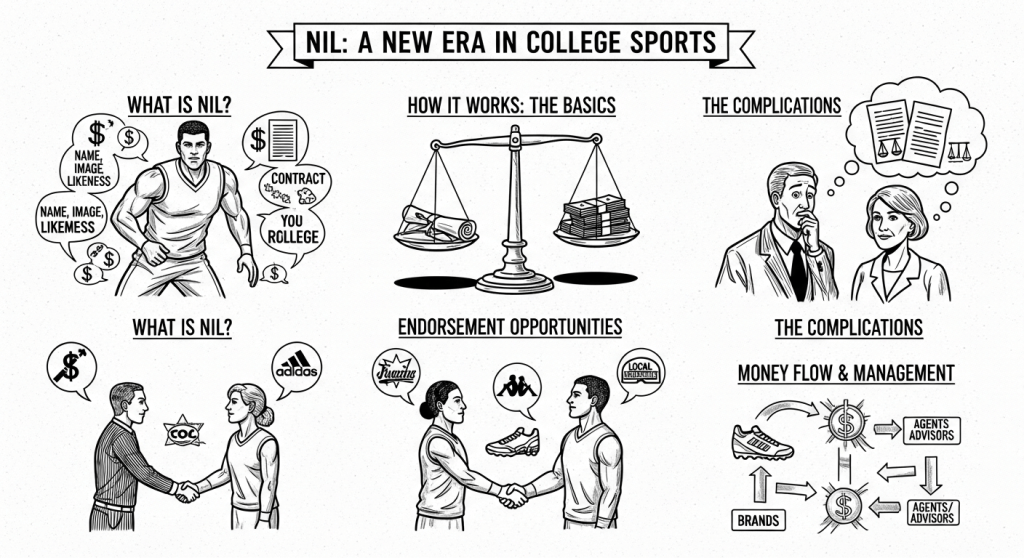
This publication serves as the definitive strategic guide for University Athletic Directors, Compliance Officers, and high-performance student-athletes navigating the complex intersection of Name, Image, and Likeness (NIL) rights, federal litigation, and institutional revenue models.
Table of Contents
- Understanding the Fundamentals: What is NIL and How Does it Function?
- The Judicial Catalyst: Key Legal Cases That Reordered College Sports
- The Evolution of NIL Collectives and the IRS Regulatory Shift
- Revenue Sharing: The Post-House v. NCAA Landscape
- Intellectual Property Strategies: Protecting the Athlete Enterprise
- Advisory Blueprint: Strategic Pointers for Athletic Departments
- The Future of Athletic Fundraising and Financial Sustainability
- References & Citations
1. Understanding the Fundamentals: What is NIL and How Does it Function?
What exactly defines Name, Image, and Likeness (NIL) in the current regulatory environment?
NIL refers to the legal right of a student-athlete to monetize their “right of publicity.” Historically, the NCAA prohibited athletes from receiving any compensation beyond a scholarship, citing the principle of “amateurism.” Today, NIL encompasses three distinct pillars:
- Name: The use of an athlete’s birth name, nickname, or social media handle in marketing.
- Image: The use of the athlete’s visual representation, including photos, videos, and digital avatars.
- Likeness: The physical characteristics, voice, or signature that uniquely identify the individual.
How does the NIL transaction process work for a student-athlete?
The process generally follows a standard commercial licensing model. An athlete enters into an agreement with a third party—ranging from local businesses and national brands to fan-funded collectives—to provide services. These services include social media promotions, public appearances, autograph signings, or content creation. In exchange, the athlete receives “fair market value” compensation.
Critically, for a transaction to remain compliant under current NCAA interim policies, it must satisfy two primary conditions:
- Quid Pro Quo: The athlete must actually perform a service to receive payment.
- No Recruiting Inducements: Payment cannot be contingent upon the athlete attending or remaining at a specific university.
2. The Judicial Catalyst: Key Legal Cases That Reordered College Sports
Which landmark court cases forced the NCAA to abandon its amateurism model?
The shift from restricted compensation to the NIL era was not a voluntary policy change by the NCAA; it was the result of sustained legal pressure and federal court rulings.
- O’Bannon v. NCAA (2014): Former UCLA basketball player Ed O’Bannon sued the NCAA for using his likeness in EA Sports video games without compensation. The Ninth Circuit ruled that the NCAA’s amateurism rules violated federal antitrust laws, marking the first major crack in the restrictive model.
- NCAA v. Alston (2021): This was the definitive turning point. The Supreme Court ruled 9-0 that the NCAA could not limit “education-related benefits” for athletes. Justice Brett Kavanaugh’s blistering concurring opinion famously stated, “The NCAA is not above the law,” suggesting that all NCAA compensation restrictions were vulnerable to antitrust challenges. This ruling effectively forced the NCAA to implement the “Interim NIL Policy” on July 1, 2021.
- House v. NCAA (2024 Settlement): This represents the most significant financial disruption in the history of college sports. The settlement addresses back-pay for athletes who were denied NIL opportunities before 2021 and establishes a framework for future revenue sharing. It fundamentally signals the end of the “scholarship-only” model for Power Four conferences.
3. The Evolution of NIL Collectives and the IRS Regulatory Shift
What are NIL Collectives, and why are they central to the current ecosystem?
NIL collectives are independent entities, typically founded by prominent alumni and boosters, designed to pool financial resources and facilitate NIL deals for athletes at a specific university. They function as a “third-party” bridge, allowing fans and donors to contribute to a fund that pays athletes for community service, brand promotions, or appearances.
Why did the IRS intervene regarding 501(c)(3) tax-exempt status for collectives?
In the early stages of the NIL era, many collectives organized as 501(c)(3) non-profit organizations, arguing that they served a charitable purpose by having athletes promote local charities.
However, in June 2023, the IRS Office of Chief Counsel issued a General Legal Advice Memorandum (GLAM). The IRS concluded that many NIL collectives do not qualify for tax-exempt status because their “private interest” (benefiting student-athletes financially) is not incidental to their “public interest” (charitable work). This has forced many collectives to restructure as taxable LLCs, fundamentally changing the tax deductibility of booster contributions.
4. Revenue Sharing: The Post-House v. NCAA Landscape
How will the $2.8 billion House v. NCAA settlement change athletic department budgets?
The settlement introduces a revolutionary NCAA revenue sharing model. Starting as early as the 2025-2026 academic year, universities will be permitted (though not required) to share up to roughly 22% of their average annual athletic department revenue directly with student-athletes. This cap is projected to start at approximately $20 million to $22 million per school, per year.
What are the operational challenges of implementing revenue sharing?
- Capital Allocation: Athletic Directors must now find $20M+ in their existing budgets. This may result in the reduction of “non-revenue” sports or a significant decrease in administrative and facility spending.
- Title IX Compliance: There is ongoing debate and potential litigation regarding how revenue sharing must be distributed between male and female athletes. If schools apply the 22% cap, they must ensure the distribution does not violate federal gender equity laws.
5. Intellectual Property Strategies: Protecting the Athlete Enterprise
Why is IP protection critical for modern student-athletes?
In the NIL era, an athlete is a business entity. Without proper intellectual property (IP) protection, they risk losing control of their brand to “squatters” or unscrupulous agents.
- Trademarking: Athletes should file for trademarks on unique catchphrases, logos, and nicknames. For example, a “Class 025” trademark covers apparel, while “Class 041” covers entertainment and educational services.
- Right of Publicity: This is a state-law-governed right. Athletes must understand that their NIL is a transferable asset. Contracts must be reviewed to ensure they are not signing away their “perpetual” rights to a brand for a one-time payment.
- Group Licensing: This allows athletes to participate in “group” deals, such as jersey sales or video game appearances (e.g., EA Sports College Football 25). Universities are increasingly facilitating these deals through agencies like OneTeam Partners or Altius.
6. Advisory Blueprint: Strategic Pointers for Athletic Departments
For athletic departments acting as consultants to their athletes and stakeholders, the following pillars are essential for institutional stability:
A. Establish a “General Manager” Role
Modern athletic departments need an “NIL General Manager” (GM). This individual sits between compliance, the collective, and the coaching staff. The GM manages the “roster value” and ensures that the school’s NIL offerings are competitive without crossing the line into prohibited recruiting inducements.
B. Audit the Collective’s Governance
University leaders should perform a “due diligence” audit on the collectives associated with their brand.
- Is the collective transparent in its disbursements?
- Does it have a robust contract for every transaction?
- Is it prepared for the IRS shift from 501(c)(3) to LLC?
A scandal at the collective level can cause irreparable reputational damage to the university.
C. Prioritize Financial Literacy and Wealth Protection
The influx of six-figure and seven-figure deals for 18-to-22-year-olds creates massive tax and legal liability. Departments should mandate financial literacy programming that covers:
- Estimated Tax Payments: Many athletes fail to set aside the 30-40% required for federal and state taxes.
- Contractual “Morals Clauses”: Athletes must understand that their NIL deals can be terminated for conduct that reflects poorly on the brand.
7. The Future of Athletic Fundraising and Financial Sustainability
How does NIL change traditional athletic fundraising?
For decades, athletic fundraising focused on “bricks and mortar”—stadiums, locker rooms, and training centers. Now, donors are faced with “donor fatigue.” They are being asked to give to the university’s capital campaign and to the NIL collective to ensure the team can recruit top talent.
The Strategy: Universities must integrate NIL into their broader development strategy. Instead of viewing the collective as a competitor for funds, ADs should coordinate with boosters to explain that “Facility Fund A” provides the infrastructure, while “NIL Fund B” provides the human capital.
Is the current NIL model sustainable?
The current model is in a state of high-velocity transition. The House settlement suggests a move toward a professionalized, contractual relationship between schools and athletes. We anticipate:
- Standardized Contracts: A shift away from “handshake deals” toward uniform NIL contracts.
- Centralized Clearinghouses: A national entity to verify that NIL deals are truly for “fair market value” and not just disguised recruiting payments.
- Federal Legislation: The NCAA continues to lobby Congress for a federal NIL law that would preempt the current “patchwork” of varying state laws, providing a single set of rules for all schools.
High-Credibility FAQs for Athletic Leadership
Q: Can a university directly pay an athlete for NIL?
A: Currently, under most state laws and NCAA interim rules, the school cannot directly pay for NIL. However, the House v. NCAA settlement is paving the way for a revenue-sharing model where the school will essentially pay a “participation fee” or share of revenue, which functions similarly to direct payment.
Q: How does Title IX apply to NIL Collectives?
A: Because collectives are third-party entities, there is a legal argument that they are not bound by Title IX. However, if a university is “significantly involved” in directing the collective’s activities or providing it with donor lists, the line blurs. Courts are likely to scrutinize this “nexus” heavily in the coming years.
Q: What is the biggest risk to a student-athlete’s NIL brand?
A: Improper IP management and lack of “Contractual Exit Strategies.” Athletes often sign multi-year deals that don’t account for them transferring to another school or entering the professional draft. We advise all athletes to include “Transfer Clauses” and “Professional Leap Clauses” in every NIL agreement.
Call to Action: Secure Your Athletic Future
The NIL landscape moves faster than the legal frameworks governing it. For student-athletes, the time to audit your personal brand and protect your intellectual property is now—before you sign a contract that compromises your future earnings.
For University Athletic Directors and Compliance Officers, the transition to a revenue-sharing model requires a total recalibration of your financial and legal strategy.
Consult with the NIL Advisory Hub. Our team of experts provides elite-level strategy, compliance audits, and IP protection blueprints to ensure your program doesn’t just survive the NIL era—it leads it.
References & Citations
Title IX of the Education Amendments of 1972, 20 U.S.C. § 1681 et seq.
NCAA v. Alston, 594 U.S. ___ (2021). Supreme Court of the United States.
IRS General Legal Advice Memorandum (GLAM) 2023-004, “Tax-Exempt Status of NIL Collectives” (June 2023).
House v. NCAA Settlement Agreement, Case No. 4:20-cv-03919-CW (N.D. Cal. 2024).
O’Bannon v. NCAA, 802 F.3d 1049 (9th Cir. 2015).
NCAA Interim Name, Image, and Likeness Policy (Updated 2024).
The Sherman Antitrust Act, 15 U.S.C. §§ 1–7.
 become the business magazine™
Leave a comment