By: Sid Peddinti, Esq.
Nonprofit, Tax, and NIL Researcher, Publisher, and Lawyer, TEDx Speaker. Advisor To Nonprofit Boards.
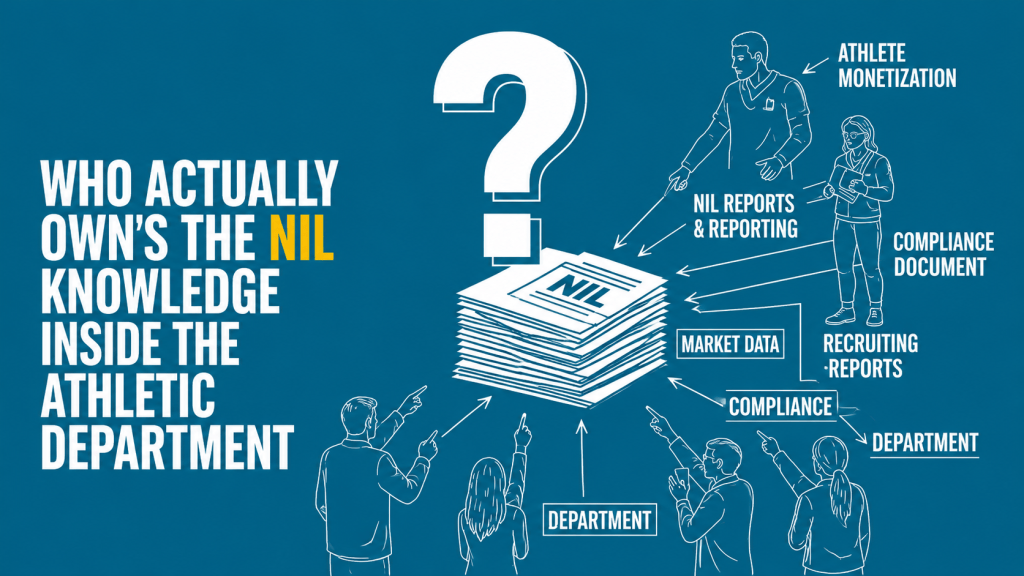
In the current landscape of collegiate athletics, data is the only currency that doesn’t depreciate. As Name, Image, and Likeness (NIL) evolves from a disruptive novelty into a multi-billion-dollar foundational pillar of sports management, the question of “who knows what” has become the most critical internal inquiry for Athletic Directors (“AD”) and University Presidents.
We are past the era of “wait and see.” We are now in the era of “search and deploy.” If your department lacks a centralized research function, you aren’t just behind the curve; you are effectively flying blind in a storm of litigation, recruiting wars, and shifting IRS guidelines.
This publication breaks down the structural architecture of NIL research, identifying the key players, the necessary functions, and the organizational strategies required to dominate the market.
Table of Contents
- The Modern Mandate: Why NIL Research is a Departmental Priority
- The NIL General Manager: The Central Hub of Intelligence
- The Compliance Function: Researching the “Can” and “Should”
- External Operations & Marketing: The Commercial Research Engine
- Third-Party Integrations: When to Outsource Intelligence
- The Role of the NIL Collective in Data Gathering
- Organizing the Internal Research Task Force: A Step-by-Step Blueprint
- Critical Data Points: What Your Research Team Should Be Tracking
- Research for Recruiting: Turning Insights into Commitments
- The Future of NIL Intelligence: Predictive Analytics and AI
- Next Steps: Audit Your Intelligence Infrastructure
- References & Citations
1. The Modern Mandate: Why NIL Research is a Departmental Priority
NIL research is no longer a peripheral task relegated to a graduate assistant. It is a core strategic function. Departments that fail to dedicate specific personnel to NIL intelligence risk three major failures:
- compliance violations
- loss of elite talent to more “data-ready” programs
- the alienation of corporate sponsors who demand ROI metrics.
Effective research answers the most pressing questions:
- What is the Fair Market Value (FMV) for a starting quarterback in our specific DMA (Designated Market Area)?
- Which local industries are under-indexed in athlete endorsements?
- How are state laws shifting in the regions where we recruit most heavily?
Without a research lead, these questions are answered with guesswork—and guesswork is a recipe for a losing season.
2. The NIL General Manager: The Central Hub of Intelligence
The most significant trend in high-major athletics is the emergence of the NIL General Manager (GM) or the Senior Associate AD for NIL. This individual is the primary architect of the department’s research strategy.
Unlike a traditional AD, the NIL GM operates like a corporate strategist. They own the “Market Intelligence” portfolio. This role is responsible for synthesizing data from compliance, marketing, and external agencies to provide the Head Coach and the AD with a real-time snapshot of the NIL ecosystem.
Key Responsibility: Centralizing fragmented data. The NIL GM ensures that the information sitting in the compliance office (contract terms) is reconciled with the information in the marketing office (fan engagement metrics) to build a holistic view of an athlete’s brand power.
3. The Compliance Function: Researching the “Can” and “Should”
Historically, compliance was about saying “no.” In the NIL era, the Compliance Office has transformed into a regulatory research unit. Their research focus is twofold:
- Legislative Tracking: With NIL laws varying wildly from state to state (and the NCAA frequently updating its “clarifications”), the compliance team must conduct daily research on legal precedents. They are the frontline researchers for “Safe Harbor” provisions and institutional involvement limits.
- Fair Market Value (FMV) Auditing: To protect the university from NCAA inquiries regarding “disguised inducements,” the compliance team must research what constitutes a “fair” payment for specific services. This requires benchmarking social media post rates, appearance fees, and autograph values against national averages.
4. External Operations & Marketing: The Commercial Research Engine
While Compliance focuses on the rules, the External Operations and Marketing teams focus on the revenue. Their research is outward-facing and brand-centric.
These teams are responsible for “Audience Analytics.” They research the demographics of the university’s donor base and social media followers to identify “Brand-Athlete Fit.” For example, if research shows that a significant portion of the alumni base works in the commercial real estate sector, the marketing team will research which athletes possess the professional polish to serve as ambassadors for those firms.
The Function: This team researches the “Valuation Gap”—the difference between an athlete’s current earnings and their potential earnings based on their reach and engagement.
5. Third-Party Integrations: When to Outsource Intelligence
No department, regardless of budget, can do all the research in-house. This is where third-party platforms like Altius Sports Partners, Opendorse, and INFLCR (among others) come into play.
These entities function as the department’s “Extensile Research Arm.” They provide the macro-data that an individual school cannot see: national trends, average deal sizes across different sports (not just football and basketball), and emerging categories of NIL (such as the rise of “Life Skills” and “Financial Literacy” content).
If you are a mid-major or a smaller DI program, your “Research Team” might actually be one internal point person who manages the relationship with these third-party providers.
6. The Role of the NIL Collective in Data Gathering
Collectives are often the most well-funded research entities in the ecosystem, though they technically operate outside the athletic department. However, the most successful departments have a “coordinated but separate” research relationship with their primary collective.
Collectives conduct “Competitive Intelligence.” They research what rival collectives are paying for specific positions. This “Market Rate Research” is essential for the department to understand where they stand in the national hierarchy. While the university cannot direct the collective’s research, they must be aware of the data the collective is using to drive its fundraising and distribution strategies.
7. Organizing the Internal Research Task Force: A Step-by-Step Blueprint
How do you organize these functions? We recommend the “Hub and Spoke” model.
- The Hub: The NIL GM or a designated NIL Director.
- Spoke 1 (Legal/Compliance): Provides data on “Policy Guardrails.”
- Spoke 2 (Student-Athlete Development): Provides data on “Educational Needs” (what are athletes asking to learn?).
- Spoke 3 (Communications/Media): Provides data on “Content Performance” (which athletes are driving the most traffic?).
- Spoke 4 (Information Technology): Ensures the data is stored securely and is accessible to key decision-makers via a centralized dashboard.
8. Critical Data Points: What Your Research Team Should Be Tracking
If your research team isn’t tracking these five metrics, your strategy is incomplete:
- Deal Velocity: How many deals are being signed per month across each sport?
- Category Concentration: Are 90% of your deals coming from “Local Retail”? If so, you have a research failure in national brand outreach.
- The “Retention Cost”: The researched market value required to keep a starter from entering the Transfer Portal.
- Fan Sentiment toward NIL: Researching how your specific donor base feels about NIL to tailor fundraising messaging.
- Time-on-Task Ratios: Researching how much time athletes are spending on NIL activities versus their academic and athletic requirements to prevent burnout.
9. Research for Recruiting: Turning Insights into Commitments
Recruiting is now an “Information Game.” When a 5-star recruit walks into your facility, they don’t want to hear “We have a great NIL program.” They want to see a research dossier.
The individual responsible for NIL research should be producing “Projected Valuation Reports” for recruits. These reports use historical data from current athletes with similar profiles to show a recruit their “Expected NIL Path.” This is research used as a closing tool. It demonstrates that the university has done the homework to ensure the athlete’s brand will be maximized from Day 1.
10. The Future of NIL Intelligence: Predictive Analytics and AI
The next frontier of NIL research is predictive. We are moving away from looking at what happened last month to predicting what will happen next season.
Forward-thinking departments are starting to use AI to scan social media trends and predict which “niche” sports (like gymnastics or volleyball) are about to see a surge in brand interest. The “Who” in your department responsible for this will likely be a Data Scientist—a role that didn’t exist in athletic departments five years ago but is becoming indispensable today.
11. Call to Action: Audit Your Intelligence Infrastructure
The gap between the “Haves” and “Have-Nots” in college sports is no longer just about facilities; it’s about information.
For Student-Athletes: If you don’t know who the NIL research lead is at your school, find out. Ask them for a report on your current brand valuation and where the “white space” is for your personal growth.
For Athletic Directors & University Leaders: Is your NIL research fragmented across five different offices with no one person owning the narrative? It’s time for a structural audit.
Consult with the NIL Advisory Hub: Our team specializes in auditing departmental structures and implementing NIL Intelligence Units that drive results. Don’t let your program operate on assumptions. Get the data. Secure your future.
12. References & Citations
Sports Business Journal: “The New Front Office: Why Data Analysts are the Newest Hire in College Sports.” (July 2024).
NCAA NIL Policy Updates (2024-2025): “Interim Policy Guidance on Institutional Involvement.” NCAA.org.
State of California NIL Legislation: “The Fair Pay to Play Act and subsequent amendments regarding institutional research mandates.” California Legislative Information.
Opendorse Data Report (2024): “The NIL Market Evolution: National Averages and Category Trends.”
Altius Sports Partners Research: “The Rise of the NIL General Manager in Power 5 Athletics.”
San Diego NIL Club & Resource Center: Insights on collective-driven market research and athlete valuation models. https://www.sandiegonil.com/
NIL Resource Center: Compliance and research frameworks for mid-major institutions. https://www.nilresourcecenter.org/
 become the business magazine™
Leave a comment